Objectivity
Our writing informs without pressure, focusing on process structure, terminology, and control considerations.
Pacífico Valoría delivers premium clarity on how AI-assisted decision tools can be woven into financial workflows. Content arrives as modular blocks—data inputs, decision rules, execution steps, and audit trails—designed to illuminate governance, transparency, and operational consistency.
We present objective narratives to help readers grasp process design, monitoring concepts, and control checkpoints that accompany automated execution systems. Pacífico Valoría does not offer personalized advice or guarantees of outcomes.
Pacífico Valoría seeks to deliver crisp, compliance-minded explanations of automation concepts in financial services. We illustrate how rule sets, model outputs, and monitoring layers can form auditable workflows with clearly defined control points.
We break content into tangible components—data inputs, constraints, routing logic, and review steps—so readers see how real-world systems are typically arranged.
We emphasize access permissions, change history, and oversight routines to illustrate how organizations keep automation aligned with policies and obligations.
Our pages prioritize process descriptions and operational considerations, avoiding promises of guaranteed outcomes and maintaining a factual, measured tone.
Pacífico Valoría centers on responsible communication about financial workflows, automation, monitoring, and governance. These beliefs shape topic selection and how information is conveyed.
Our writing informs without pressure, focusing on process structure, terminology, and control considerations.
We spotlight safeguards, monitoring, and review routines to show how safeguards support automation-centric operations.
We emphasize time-stamped records and structured summaries that enable accountable review workflows.
We outline role-based access and change-control practices that assign clear responsibility for configuration decisions.
Pacífico Valoría material is produced with a documentation-first approach. Topics are organized into consistent page layouts that cover definitions, workflow steps, and operational controls, prioritizing readability and cross-device accessibility.
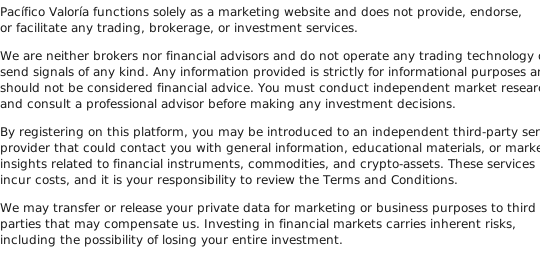
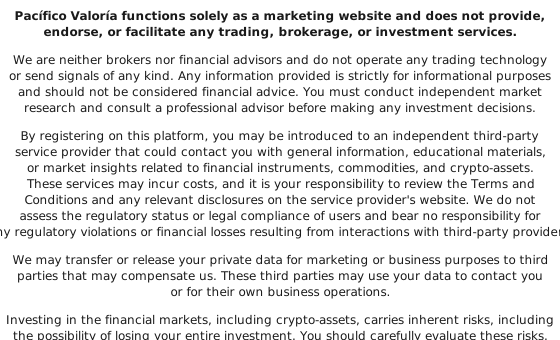
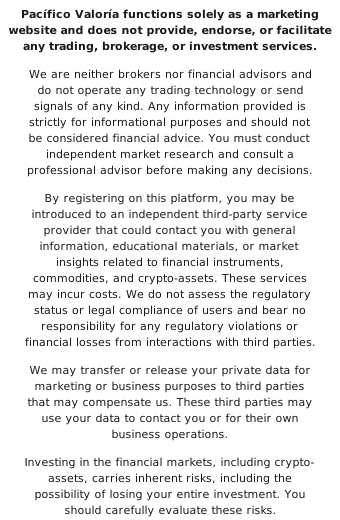
This website functions solely as a marketing platform and does not provide, endorse, or facilitate any trading, brokerage, or investment services.
Read More